
Your b2b lead generation efforts struggle to gain momentum without a steady flow of quality leads. High-quality leads translate to better ROI and ensure your team focuses on prospects ready to convert. Yet B2B buyers average 36 interactions before making a purchase. This makes the trip complex.
In this piece, I’ll walk you through building a b2b lead generation funnel that converts. We’ll cover the b2b funnel stages, proven b2b lead generation strategies, optimization tactics for your lead generation sales funnel, and common mistakes that derail conversions.
Table of Contents
- What is a B2B lead generation funnel
- Understanding B2B lead generation funnel steps
- How to build a lead generation funnel step by step
- B2B lead generation strategies that drive conversions
- Optimizing your lead generation funnel for better results
- Common mistakes that kill B2B funnel conversions
- Conclusion
- Key Takeaways
1. What is a B2B lead generation funnel
A B2B lead generation funnel is a strategic system that takes potential customers through their buying process, from first awareness of your company to the moment they’re ready to talk to your sales team. Put another way, it’s a carefully planned path designed to attract, educate and convert prospects into qualified leads.
This framework outlines the various stages a business-to-business customer goes through before making a purchase. The funnel shape reflects reality: you’ll always have more leads than customers, with each stage being larger than the following one. As prospects move through the funnel, some drop off while others progress toward becoming paying customers.
The b2b lead generation funnel isn’t just a website or marketing theory. It’s a revenue system that converts buyers from product awareness to closed deals. Built correctly, it turns your website from a digital brochure into your most effective salesperson.
The difference between B2B and B2C lead generation funnels
B2B and B2C funnels share the same simple structure, but the differences run deep. B2B sales cycles average 84 days, compared to just 29 days for B2C. The reason? Higher stakes, major investments and group decision-making processes.
B2B buyers involve 38% more people in the decision-making process than B2C buyers. You’re targeting a group rather than an individual consumer when you sell to other businesses. Multiple stakeholders must assess product-company fit, which extends the sales cycle and requires more detailed nurturing stages.
The decision-making processes vary between these two audiences. B2B buyers are logical and focus on ROI. They need time to liaise with stakeholders, share research internally and assess proposals against competitors. B2C consumers make faster decisions driven by emotions and immediate needs.
Content requirements differ. B2B funnels need case studies, whitepapers, product comparison tables, expertise articles, educational presentations, video testimonials, product tours and live demos. B2C funnels rely more on product promotion and attractive advertising.
Lead generation for B2B takes an average of 12 points of contact to turn a prospect into a sales-qualified lead. Your marketing team nurtures each lead until they reach sales-qualified status. B2C lead generation moves quickly: the customer sees your product, reads reviews, participates with content and buys.
The B2B market is narrower and more tailored. You might need to approach an entire network of names within an organization to reach the person with purchasing power. Trust must be gained through expertise, judgment and proven solutions. B2C businesses focus on short-term relationships with mass appeal.
Why conversion-focused funnels matter for B2B growth
Conversion-focused funnels should be built to meet revenue targets, not just lead counts. The main goal becomes determining pipeline and channel requirements to meet ARR goals. Without this focus, you’ll generate volume without measurable growth.
Leads leak out of the funnel at all stages. Some people call this problem “the dark funnel.” Lost leads equal lost revenue, especially when good-quality prospects drop off who could have become loyal customers. A conversion-focused approach plugs these leaks by addressing buyer behavior at each stage.
The demand generation funnel must offer confidence that marketing drives revenue. Results should be tracked at each stage, focusing on metrics that affect the business: sales-qualified opportunities, pipeline value, win rate, CAC payback and expansion effect.
Buyers with high-intent signals must be handled with urgency and quickly routed to the right representative. Companies with response times under five minutes see higher conversion rates to meetings held. Speed matters when prospects are ready.
A conversion-focused funnel arranges sales and marketing around buyer behavior rather than internal milestones. Stage definitions reflect real buyer readiness instead of arbitrary rules. This arrangement improves team coordination and ensures each member takes actions consistent with the overall goal.
Conversion optimization also identifies inefficiencies. You can spot bottlenecks or drop-off points and optimize them strategically by analyzing how prospects move through the funnel. This has upgrading stages with better conversion techniques, reducing friction and streamlining the customer process.
2. Understanding B2B lead generation funnel stages
Each stage of your b2b lead generation funnel serves a distinct purpose in moving prospects closer to a purchase decision. You can deliver the right content to the right people at the right time when you understand these stages.
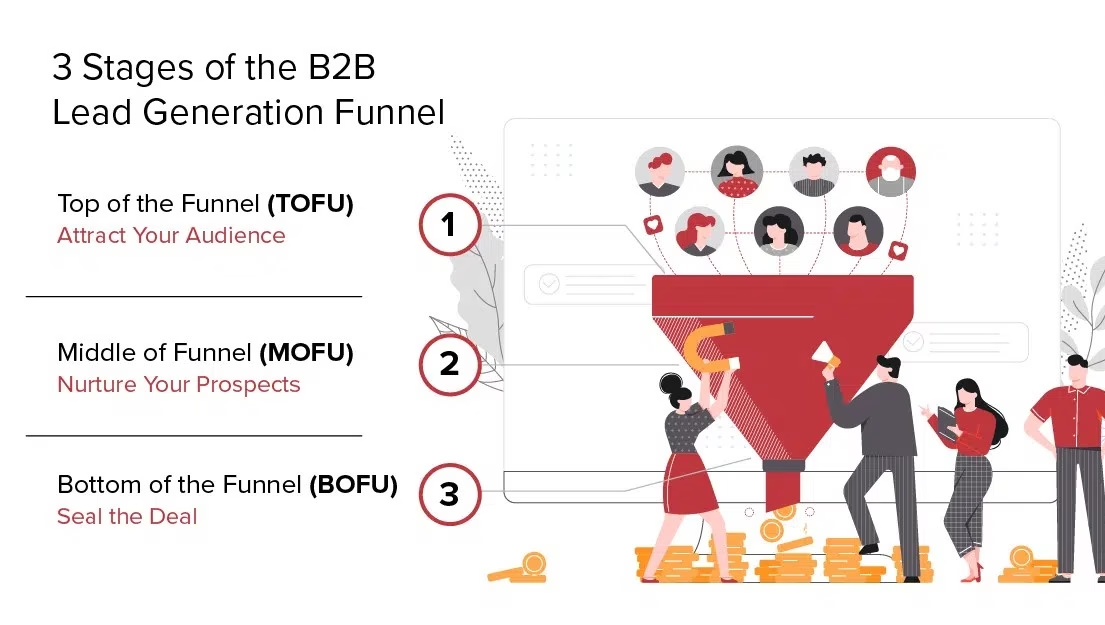
Top of funnel: Awareness and finding
The awareness stage captures attention from prospects who are just beginning to identify a business problem. Your audience knows they face a challenge at this point, but they’re still defining what that challenge is. They’re researching and learning. They’re trying to put language around their problem.
Your goal here centers on education rather than selling. TOFU content builds brand awareness and establishes your company as an expert in your industry. Prospects enter the assessment stage already familiar with your brand and view. That’s top of funnel doing its job.
Blog posts addressing specific questions work well as TOFU content. Research studies providing data and infographics making complex information digestible also help. Webinars going deep on topics and social media content positioning your team as experts round out the mix. The key across all formats: provide useful information without requiring prospects to think about your product.
You’ll want to track different metrics at this stage. Focus on website traffic from organic search and social media reach. Content downloads, webinar registrations and newsletter sign-ups matter. Time spent on content pages tells you something too. Brands applying a full-funnel strategy gain 45% higher ROI compared to competitors focusing on a single stage. Don’t expect immediate pipeline or revenue attribution from TOFU. These prospects aren’t ready to buy yet.
Middle of funnel: Assessment and participation
Leads progress into the middle of funnel stage once they convert on TOFU content. Prospects assess solutions and compare options at this point. Most B2B deals go to die in the mid funnel, and most marketers don’t realize it’s happening.
The mid funnel doesn’t get the attention it deserves because it’s messy and hard to measure. Top-of-funnel metrics are easy: clicks, downloads, MQLs. Bottom-of-funnel metrics are clear: pipeline, revenue, deal size. The middle is a complex mix of account-level participation, buying group expansion and intent escalation.
MOFU content must answer “how does this work?” and “is this right for us?” That means case studies showing similar companies succeeding with your solution. Comparison content honestly addressing how you stack up against competitors helps too. Detailed product information helps technical evaluators understand capabilities. Generic expertise won’t move them forward. Specific information will.
Your MOFU strategy should shift from a single contact to reaching multiple stakeholders. Your content syndication program generated a lead from a demand generation manager. Your mid funnel strategy should focus on identifying the data science team, marketing ops and executive decision-makers at that same account.
Bottom of funnel: Decision and conversion
BOFU targets people nearing a purchase decision and researching solutions to their specific needs. The key benefit of developing bottom funnel content is the outsized revenue impact it can deliver.
Bottom funnel content allows you to intercept prospects who have already been warmed up by your brand or maybe even your competitors when executed well. You’re targeting people deeper in the buyer’s journey. BOFU content helps shorten sales cycles. Your sales team can focus on qualified prospects much closer to a purchasing decision instead of taking cold leads through early education stages.
BOFU content combines specific elements in a compelling way. Connect your product features to the specific benefits they deliver at a granular level. Address major pain points. The goal is demonstrating a direct through line from influential user challenges all the way to detailed product capabilities.
Product demos and trials work as typical BOFU content. ROI calculators and customer testimonials help. Pricing information and implementation previews round out the mix. Create landing pages, lists and lead magnets that address specific pain points and offer immediate solutions.
Common patterns show you can achieve ranking in about 60 days, then subsequent visibility. First conversions come in 90 days. More specific keywords are easier to move to the top, as there are almost no competitors fighting for them.
3. How to build a B2B lead generation funnel step-by-step
Building your b2b lead generation funnel requires a systematic approach that transforms abstract strategy into concrete pipeline. Each component must work together to move prospects from discovery through to sales qualification.
Define your ideal customer profile and target audience
Analyze your last 50 closed deals to identify firmographics, technographics, and behavioral patterns. An ideal customer profile represents a snapshot of companies that would be a perfect fit for your solution. This includes variables such as industry, location, company size, business model, pain points, and technologies used.
Companies that establish clear ICPs see 36% higher customer retention rates and 38% higher sales win rates. Your ICP should include specific attributes with ranges rather than vague descriptors. A precise ICP might read: “SaaS companies, USD 2.00M to USD 20.00M ARR, 50 to 200 employees, using HubSpot or Salesforce, hiring for sales roles in the last 90 days, based in North America”.
Build your ICP through five steps: establish your data foundation, define success criteria, identify your best-fit customers, conduct analysis to find commonalities, and outline your profile. Interview your sales team to understand which deals closed fastest and which prospects wasted time. Negative signals matter as much as positive ones.
Map out your customer trip and touchpoints
Customer trip mapping documents every interaction prospects have with your brand, from original awareness through sales engagement. This visual representation helps identify gaps where prospects might disengage and reveals optimization opportunities that improve conversion rates.
McKinsey’s 2024 B2B Pulse Survey shows that touchpoints fall into three equally weighted modes: in-person interactions, remote human-assisted channels, and self-service digital platforms. Map all touchpoints including your website, sales calls, customer support, and onboarding to understand the complete path.
Buyers switch among different modes of interaction and create an omnichannel trip. Buying groups gather between 24 and 50 pieces of information that must be reviewed and analyzed collectively. Your trip map should extend from awareness-raising touchpoints through usage-associated touchpoints like support services and account teams.
Choose the right channels for lead acquisition
Modern B2B buyers participate with an average of 13 pieces of content across 7 different channels before making purchase decisions. Companies with sophisticated content strategies generate 67% more leads than competitors and achieve 62% lower cost per acquisition.
LinkedIn generates 80% of B2B social media leads and delivers 277% higher conversion rates than other platforms. Webinars generate leads with 73% higher qualification scores compared to other channels. Attendees convert at 2.3x higher rates. Email marketing generates USD 36.00-42 for every USD 1.00 spent.
Your timeline determines the optimal channel mix. Cold outreach wins for pipeline needed in 30-60 days. Content marketing, SEO, and partnerships serve as long-term plays with compounding returns.
Create valuable content for each funnel stage
TOFU content should spark awareness through blog posts, infographics, videos, and authority pieces. Buyers want to understand trends and find answers to pain points without being sold to at this stage.
MOFU content deepens consideration with case studies showing real examples with metrics, webinars building authority, and white papers explaining your approach. Gate some content like ebooks or webinars in exchange for contact information.
BOFU content drives conversion through product demos, customer testimonials with specific outcomes, and FAQ documents addressing last-minute questions. Share lead engagement insights with sales for a seamless handoff.
Set up lead capture mechanisms and forms
Poor form design or excessive required fields cause nearly 70% of B2B websites to lose leads. Keep forms short by asking only for essential details like name, email, and company information.
Multi-step forms outperform single-step versions by up to 30%. They break the process into digestible, low-friction steps. Use clear field labels, smart field logic to show or hide fields based on previous answers, and ensure mobile-friendly design.
Ask for name and email only for prospects in the early awareness stage. Add specific qualifying questions to filter out lower-quality leads for serious buyers who are thinking about options.
Build email nurturing sequences for lead qualification
Lead nurturing guides prospects through the funnel by delivering timely, relevant, and personalized content addressing their specific challenges. Emails tailored to specific audience segments see 30% more opens and 50% higher click-through rates than generic campaigns.
Segment based on industry, job role, behavior, and engagement history. Progressive profiling collects simple info first, then gathers more details as trust builds. Your nurturing sequences should have branches for people to go down based on their behaviors, with a clear golden path you want leads to follow.
Automated email sequences achieve 29% higher open rates and 41% higher click-through rates than generic campaigns. Companies using automated lead qualification see a 20% increase in lead conversion rates.
4. B2B lead generation strategies that drive conversions
Execution separates b2b lead generation strategies that fill pipelines from those that waste budget. The tactics below work because they target buyers where they already search, learn, and make decisions.
SEO and paid search for findability
SEO generates more leads than any other b2b lead generation initiative according to 57% of marketers, with SEO leads closing at 14.6% compared to just 1.7% for traditional outbound. Organic search accounts for roughly 53% of all trackable website traffic. B2B companies generate up to 2x more revenue from organic search than any other digital channel.
The change toward intent-driven keywords matters more than search volume. Target queries like “software for [industry],” “[problem] solution,” and “[competitor] alternative” because these terms signal buying motion rather than curiosity. Keywords with buying signals such as “best,” “top,” “vs,” “alternative,” and “pricing” should be your priority.
Paid search works when combined with account-based marketing tools. Platforms like 6sense, ZoomInfo, and HubSpot create contact lists and integrate with Google and Microsoft Ads. They customize landing pages to prevent ad spend waste on consumers rather than business buyers. Hyper-personalization becomes possible with first-party data. You can target high-intent audiences with specific messaging.
Webinars and events that convert prospects
Webinars produce the best results among all marketing channels for 51% of B2B marketers. 73% of B2B marketing and sales professionals identify webinars as the greatest approach to creating quality leads.
Intellectual influence webinars at the top of funnel establish credibility and attract wide audiences of potential customers. Solutions-focused webinars and product demos work in the middle of funnel. They allow real-time interaction through live chat, Q&A, and polling. Engagement scoring tools, post-event surveys, and attendee behavior data help qualify leads more accurately than static content.
Post-webinar follow-up drives conversions. Send customized emails with recordings, additional resources, and exclusive offers to keep leads engaged. Nearly 50% of webinar registrations don’t attend live. Follow-up sequences become necessary to maximize conversions.
Account-based marketing for high-value targets
ABM targets specific high-value accounts with customized messaging rather than casting a wide net. This approach makes sense when your LTV or ACV exceeds USD 30,000, you deal with multiple buying committee members, or your market is limited to 500-1,000 companies globally.
Companies with ABM programs report 97% achieving higher ROI than any other marketing initiative. ABM lead generation gives your team a major head start and encourages cooperation between sales and marketing. This leads to higher returns.
Social selling and intellectual influence
Social selling leaders create 45% more opportunities than peers with lower social selling index scores. These sellers are 51% more likely to reach quota. 78% of social sellers outsell peers who don’t use social media.
The approach centers on building authentic relationships rather than pitching. Participate in conversations about industry pain points on prospects’ posts and offer helpful insights. Establish yourself as an intellectual influence before initiating sales conversations. Intellectual influence shapes how prospects notice your brand long before they participate with your team. This makes every step of the buying experience easier.
5. Optimizing your lead generation funnel for better results
Data transforms your b2b lead generation funnel from guesswork into a precision system. Track conversion rates at each funnel stage and identify where prospects leak out. Lead to MQL should convert at 25-35%, MQL to SQL at 13-26%, SQL to opportunity at 50-62%, and opportunity to close at 15-30%. When your numbers fall below these measures, you’ve pinpointed where to focus improvement efforts.
Track the right metrics at each stage
Pipeline velocity measures how quickly leads move from first touch to closed deal. Calculate it by multiplying number of opportunities by average deal value by win rate, then divide by sales cycle length. This metric connects your b2b lead generation process to revenue efficiency. Monitor your LTV to CAC ratio as well, with healthy funnels showing 3:1 or better. Friction exists somewhere in your funnel if CAC climbs or velocity slows.
A/B test your landing pages and CTAs
A/B testing removes guesswork and provides data-based evidence about what improves conversion rates. Test one variable at a time and attribute improvements to specific changes. Headlines and CTA wording are high-impact tests, along with form length and social proof placement. Landing pages with 5 or fewer fields convert 120% better than longer forms. Run tests with at least 1,000 visitors per variation and maintain 95% confidence levels.
Improve lead qualification with scoring
Lead scoring assigns numerical values based on how prospects are to convert. Companies with mature lead scoring models report 77% higher conversion rates. Use explicit scoring (demographic data prospects tell you) and implicit scoring (behavioral attributes). Firmographic criteria include company size and industry, while behavioral signals track website visits, content downloads, and email engagement.
Reduce friction in the conversion process
Every form field creates a conversion barrier that costs leads. Progressive profiling collects simple information first, then gathers more details as trust builds. Budget or timeline fields asked too early suppress legitimate demand. Reduce forms from twelve to six fields, add calendar booking, and route enterprise leads to AEs. This improves both speed and quality.
6. Common mistakes that kill B2B funnel conversions
Even well-designed funnels fail when execution stumbles on common mistakes. Most B2B lead generation programs struggle with four critical issues that affect conversion rates.
Focusing on quantity over lead quality
The broader you cast your net, the vaguer your message becomes. Only 12% of B2B marketing-generated leads convert to revenue. Companies celebrate lead volume while sales teams struggle with low conversion rates. This reveals a fundamental disconnect. Marketing incentivized on lead volume alone generates unqualified prospects that drain resources. High-quality leads participate more with content and respond to outreach. They progress through the funnel faster. Businesses with strong sales and marketing teams lined up see up to 36% higher customer retention.
Gating too much content too early
Companies with aggressive gating practices lose up to 57% of potential leads in the early research phase. Generic whitepapers and product-oriented content record abandonment rates over 80% even with minimal form requirements. The modern approach gates based on audience and expectation, not just funnel stage. Keep your most valuable intellectual influence ungated to establish authority and reach the widest audience.
Poor sales and marketing coordination
This disconnect costs B2B companies 10% or more of revenue loss each year. Sales and marketing departments waste approximately USD 1.00 trillion each year due to lack of coordination. Marketing promises one thing in ads while sales reps talk about different values during demos. This setup fails. Most marketing content goes unused by sales, sometimes because it’s not relevant or hard to find.
Neglecting post-conversion nurturing
Most B2B lead nurturing strategies focus on sending content rather than the psychology of buying decisions. Nurture emails arrive before buyers show meaningful intent. This creates an impression of pushiness. Buyers need compelling case studies and ROI evidence at middle and bottom of funnel. They also need implementation walkthroughs and internal buy-in resources. Without intent-based lead nurturing triggers, timing becomes guesswork that rarely lines up with buyer decision cycles.
7. Conclusion
Building a B2B lead generation funnel that converts requires more than just understanding the stages. You need the right strategy and content working together. Start by defining your ideal customer profile, then map their experience through awareness, consideration, and decision stages. Focus on lead quality rather than volume and line up your sales and marketing teams. Track the metrics that matter most.
Your funnel should evolve based on data. Test your landing pages and refine your lead scoring. Reduce friction wherever prospects drop off. Therefore, you’ll see better conversion rates, shorter sales cycles, and higher ROI from your lead generation efforts.
8. Key Takeaways
Building a high-converting B2B lead generation funnel requires strategic focus on quality over quantity, proper stage alignment, and continuous optimization based on data-driven insights.
• Define your ideal customer profile precisely – Companies with clear ICPs see 36% higher retention rates and 38% higher sales win rates by targeting specific firmographics and behaviors.
• Create stage-specific content that matches buyer intent – Top-funnel focuses on education, middle-funnel on solution comparison, and bottom-funnel on decision-making with demos and ROI proof.
• Track conversion metrics at each stage to identify leaks – Monitor lead-to-MQL (25-35%), MQL-to-SQL (13-26%), and opportunity-to-close (15-30%) rates to pinpoint optimization opportunities.
• Align sales and marketing around buyer behavior – Misalignment costs B2B companies 10% of revenue annually, while aligned teams achieve faster sales cycles and better lead quality.
• Optimize for quality leads, not volume – Only 12% of marketing-generated leads convert to revenue, making lead scoring and qualification essential for funnel efficiency.
Remember: Your B2B funnel should function as a revenue system that guides prospects through a 36-interaction journey, not just a lead collection mechanism. Focus on reducing friction, providing value at each stage, and maintaining consistent messaging from marketing through sales handoff.
FAQs
Q1. What is the main difference between B2B and B2C lead generation funnels? B2B funnels have significantly longer sales cycles (averaging 84 days versus 29 days for B2C) and involve multiple decision-makers, with 38% more people participating in the buying process. B2B buyers focus on logical ROI-driven decisions and require detailed content like case studies and whitepapers, while B2C consumers make faster, emotion-driven purchases based on immediate needs.
Q2. How many touchpoints does a typical B2B buyer need before making a purchase? B2B buyers average 36 interactions before making a purchase decision and engage with approximately 13 pieces of content across 7 different channels. The buying process requires between 24 and 50 pieces of information to be reviewed and analyzed collectively by the buying group, making the journey complex and requiring sustained nurturing efforts.
Q3. What are the ideal conversion rates for each stage of a B2B sales funnel? Healthy B2B funnels should see lead-to-MQL conversion rates of 25-35%, MQL-to-SQL rates of 13-26%, SQL-to-opportunity rates of 50-62%, and opportunity-to-close rates of 15-30%. When your conversion rates fall below these benchmarks, it indicates specific stages in your funnel that need optimization and improvement.
Q4. Why do most B2B marketing-generated leads fail to convert? Only 12% of B2B marketing-generated leads convert to revenue, primarily because companies focus on lead quantity over quality. When marketing teams are incentivized purely on lead volume, they generate unqualified prospects that waste sales resources. Additionally, poor sales and marketing alignment costs B2B companies 10% or more of revenue annually.
Q5. What type of content works best at the bottom of the funnel? Bottom-of-funnel content should include product demos and trials, ROI calculators, customer testimonials with specific outcomes, detailed pricing information, and implementation previews. This content addresses the “is this right for us?” question by connecting specific product features to benefits that solve major pain points, helping prospects make final purchase decisions.
About The Author

Get A Free Consultation
I can help you grow your B2B business.
Ready to Generate 40-80+ Qualified Leads/Month?
Get a free 30-minute Growth Blueprint call. You’ll learn:
- Your current cost per lead vs. industry benchmarks
- Which channels are leaving money on the table for firms like yours
- A 90-day roadmap to predictable lead generation
- Specific positioning recommendations for your segment
No sales pitch. Just honest advice.